How to Choose the Best Mesh Wire for Your Project?
Choosing the right mesh wire for your project can seem daunting. According to industry expert John Smith, "Quality mesh wire can make or break your installation." His words resonate in a market filled with options. Different projects demand different types of mesh wire. You need to consider its strength, gauge, and intended use.
Mesh wire comes in various materials, such as stainless steel, galvanized steel, and plastic. Each type has its advantages and disadvantages. For instance, stainless steel offers excellent corrosion resistance but can be costly. On the other hand, plastic mesh wire is lighter and easier to work with but may not hold up under heavy loads.
Selecting the best mesh wire involves reflecting on your project's specific needs. Are you building a fence, supporting plants, or creating art? Each application requires a unique approach. Remember, the right choice can enhance durability and functionality. However, it is crucial to avoid common mistakes, such as overlooking environmental factors. Your choice in mesh wire deserves thoughtful consideration.
Understanding Different Types of Mesh Wire Materials for Projects
When it comes to choosing mesh wire for your project, understanding different materials is key. Steel mesh is strong and durable. It works well for construction and security. However, it can be heavy, making it less ideal for lightweight applications.
Aluminum mesh offers good corrosion resistance and is much lighter. It's great for projects like gardening or ventilation. Yet, it may not hold up well under heavy load.
Plastic mesh, on the other hand, is versatile and easy to handle. It’s often used in DIY projects and fencing. The downside? It can be less durable in extreme weather conditions.
Fiberglass mesh is another option, providing excellent resistance to different environmental factors. However, it can be more challenging to work with due to its rigidity. Each material has its pros and cons, and your choice should align with your specific project needs.
Consider factors like strength, weight, and the environment before making a decision.
Remember, the perfect fit exists, but it may require some trial and error.
Evaluating Wire Gauge and Size for Your Specific Needs
Choosing the right mesh wire for your project involves careful evaluation of wire gauge and size.
Wire gauge indicates the thickness of the wire, affecting its strength and flexibility.
For example, a 14-gauge wire has a diameter of approximately 1.63 mm, making it robust for heavy-duty applications.
Conversely, a 20-gauge wire is thinner at around 0.81 mm, suitable for lighter tasks.
Consider the specific needs of your project. A heavier wire may offer superior durability, ideal for outdoor fencing or structural supports.
Yet, this robustness can also mean increased difficulty in manipulation and installation.
A 2009 industry report noted that improper gauge selection led to a 30% increase in project costs due to rework and material waste.
Additionally, the size of the mesh openings plays a crucial role. Smaller openings can prevent smaller animals from passing through, but they can also restrict airflow and light, impacting plant growth in garden applications.
Evaluating these factors can lead to better outcomes. Ultimately, understanding your unique requirements and the implications of gauge and size is essential.
It’s a decision that warrants careful thought, as the wrong choice can create significant hurdles down the line.
Considering Corrosion Resistance and Durability Factors
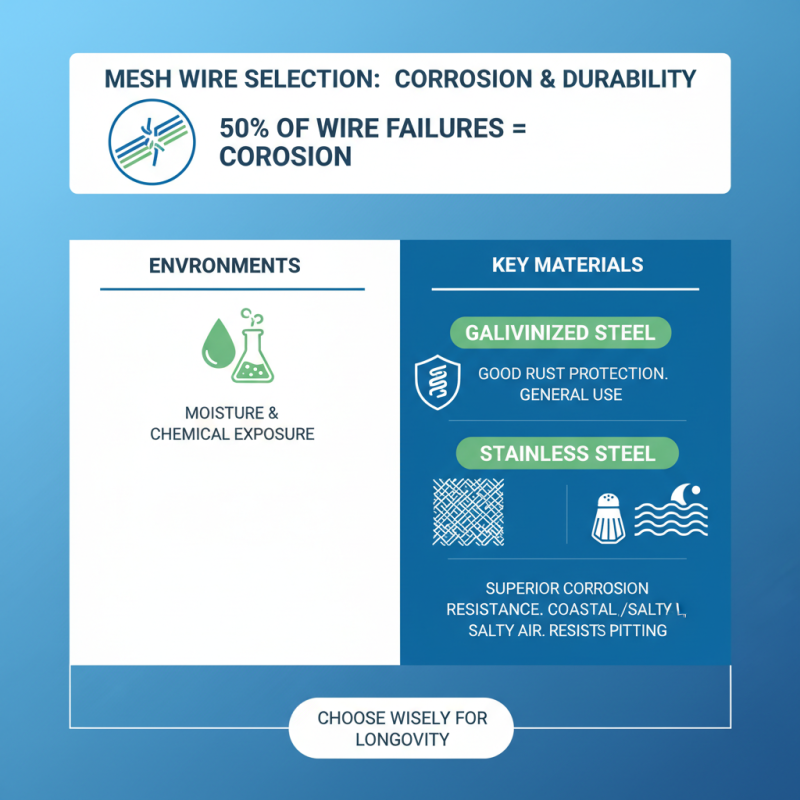
When choosing mesh wire, corrosion resistance and durability are critical factors. Studies show that 50% of wire failures occur due to corrosion. In environments exposed to moisture or chemicals, selecting the right material becomes essential. Galvanized steel offers excellent rust protection, but in coastal areas, stainless steel may be necessary. Stainless steel features a higher resistance to pitting and crevice corrosion, especially in salty air.
Another aspect to consider is the wire's tensile strength. Research indicates that stronger wire can withstand greater loads and environmental stress. For instance, a wire with 200,000 psi tensile strength is often recommended for structural applications. However, while strong materials last longer, they may also be more expensive. Reflecting on budget constraints can lead to a compromise between cost and durability.
Venturing into specifics, the wire mesh's weave pattern affects airflow and resistance to debris buildup. A tighter weave may be better for certain applications, such as filtration. Yet, it may restrict airflow too much in some cases. Evaluating the particular needs of your project helps in making the right choice. Balancing durability with other project requirements can be challenging but is vital for long-term success.
Identifying the Appropriate Mesh Pattern for Your Application
When choosing a mesh wire for your project, understanding the appropriate mesh pattern is crucial. Different applications require varying mesh configurations. For instance, a tighter mesh is ideal for filtration. It ensures only small particles pass through while larger ones are blocked. On the other hand, a looser pattern might be better suited for protection or reinforcement.
Not every mesh pattern works for every project. A misstep in pattern choice might lead to issues down the line. Consider the environmental conditions too, as they impact durability. A mesh used in a wet area will need different properties than one in a dry climate. Visualize your project. Think about how users will interact with the mesh and the purpose it serves. Reflecting on these factors can save time and resources in the long run.
Finding the right pattern requires experimentation and sometimes, failure. It may take several tries to get it right. Documenting your choices helps track what works and what doesn’t. Experiment with different patterns and assess their advantages and limitations. This approach leads to better decision-making in future projects.
How to Choose the Best Mesh Wire for Your Project
This chart illustrates the strength of different mesh patterns based on wire diameter. Analyzing these values can help you identify the best mesh wire for your specific project's needs.
Assessing Cost-Effectiveness and Availability of Mesh Wire Options
When selecting mesh wire for your project, cost-effectiveness is vital. Prices can vary significantly based on material and size. Look for local suppliers to save on shipping costs. Also, check online marketplaces for competitive pricing. Remember, cheaper options may sometimes lead to durability issues. Balance your budget with quality.
Tip: Compare prices through multiple sources. This small step can reveal better deals. Don’t hesitate to reach out to suppliers for bulk discounts. They might offer better rates for large orders.
Availability is another critical factor. Some materials may be hard to find in your area. Research local supply stores. If they don’t carry what you need, consider ordering from specialists. Keep in mind that delivery times may affect your project schedule.
Tip: Always plan for delays. It’s better to have extra time for unexpected obstacles. Evaluate your project timeline when choosing mesh wire. A little extra time can save you from headaches later.
How to Choose the Best Mesh Wire for Your Project? - Assessing Cost-Effectiveness and Availability of Mesh Wire Options
| Mesh Type |
Cost per Square Foot |
Material |
Strength Rating (lbs) |
Availability (Local/Online) |
| Galvanized Steel Mesh |
$0.50 |
Steel |
1500 |
Local |
| Plastic Mesh |
$0.30 |
Polypropylene |
200 |
Online |
| Welded Wire Mesh |
$0.65 |
Steel |
1200 |
Local |
| Fiberglass Mesh |
$0.45 |
Fiberglass |
300 |
Online |
| Chain Link Fence Mesh |
$0.40 |
Galvanized Steel |
800 |
Local |